Working note No. 6 — on event risk and the temptation to exclude it.
Abstract. A systematic strategy that holds positions through scheduled information events invites an obvious refinement: step aside on the dangerous nights. We tested the refinement. Excluding event nights removed a material fraction of the strategy's long-run edge — the exclusion was not trimming risk around the edge, it was trimming the edge itself. We relate this result to the literature on scheduled-news risk premia and draw the uncomfortable conclusion: for at least one class of strategies, the nights that are hardest to hold are, in a precise and measurable sense, the product being sold.
1. Introduction
Every risk committee, formal or internal, eventually asks the same question: must we hold through the announcement? The backtested position is up, the event is binary, the overnight gap is unhedgeable. Stepping aside costs nothing but a few nights of exposure and buys an equity curve that is visibly calmer. The proposal writes its own approval.
We report what happened when we evaluated it under our standard protocol, and why the answer changed how we think about where returns come from.
2. Notation and design
Following the decomposition popularized by Lou, Polk, and Skouras (2019), write the close-to-close return of a holding as the product of its overnight and intraday components,
(1 + r_cc) = (1 + r_overnight) · (1 + r_intraday),
so that any holding rule is, implicitly, a portfolio of claims on particular r_overnight windows. Partition holding nights into an event set E (nights carrying scheduled firm-level information) and its complement. The exclusion under test is then a single restriction — forbid positions whose overnight window falls in E — and its cost is the difference in long-run strategy profit with and without the restriction, evaluated out of sample under the usual folds.1
3. The result
The exclusion did what it promised locally: the excluded nights were, individually, the strategy's most volatile holdings. But the aggregate effect was a reduction in long-run profitability large enough that no risk-adjustment we compute could rescue it.2 The removed nights were not a random sample of exposure carrying average return; they were a concentrated carrier of it. Fig. 1 summarizes the shape of the finding in stylized form: ranking holding nights by scheduled-information intensity, the contribution to cumulative profit is not spread across the ranking — it piles up violently at the top.
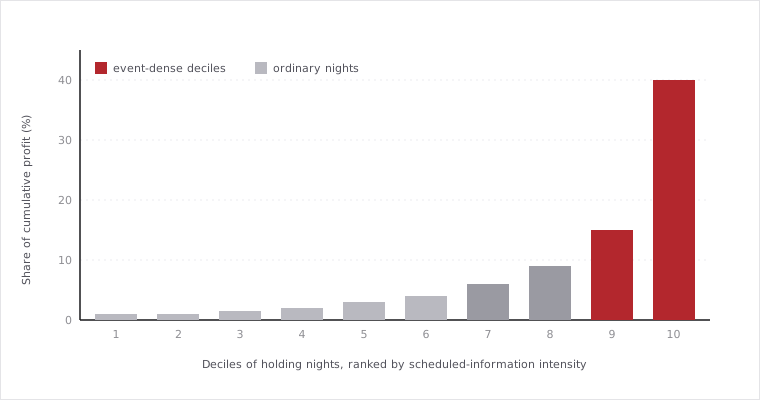
Fig. 1. This figure shows the share of cumulative strategy profit attributable to each decile of holding nights, where nights are ranked by scheduled-information intensity (decile 10 densest). Profit share rises slowly across the ordinary deciles and concentrates overwhelmingly in the two event-dense deciles, shown in red. The figure is a stylized rendering of the qualitative pattern: all values are synthetic, and levels are deliberately unspecified.
In the accounting sense the exclusion succeeded — variance fell. In the economic sense it failed, because what fell with the variance was the reason the strategy exists.
This is the tail lesson of an earlier note in different clothing, but it deserves its own treatment because the mechanism is different. There, protective exits sold a right tail generated by price continuation. Here, the exclusion sold nights on which information arrives on a schedule — and holding through scheduled information turns out to be a priced service.
4. Relation to what is known
The finding should embarrass us less than it does, because the academic record points the same direction. Savor and Wilson (2013) document that a large share of the equity premium is earned on the small number of days carrying scheduled macroeconomic announcements. The earnings-announcement premium — average abnormal returns to firms in their announcement windows — has been documented, in various forms, since Beaver (1968).3 And the Lou-Polk-Skouras decomposition is a standing reminder that expected returns are not distributed uniformly across the clock; they concentrate in particular windows for particular clienteles. Our contribution, such as it is, is merely the practitioner's corollary: if the premium lives in the scary windows, a filter that removes scary windows is a machine for returning the premium to whoever is on the other side.
We note, without detailing our configuration, that the same logic extends to other closed-market windows — weekends among them. In every case we have tested, the question "should we pay to be flat when the market is closed?" has received the same answer, and the answer is that flatness is not free; it is bought, and the price is the premium.
5. Conclusion
The general principle we take from this study: before excluding a class of exposure, compute what fraction of the edge lives there. The exposures a strategy's operator most wants to remove — the binary nights, the gap risk, the positions that make weekends long — are disproportionately likely to be the exposures the market pays that strategy to hold. Comfort, as in our earlier notes, turns out to be the most expensive thing a systematic portfolio can buy.
Notes
- Membership in E is determined ex ante from the public calendar; nothing in the classification uses information unavailable at the close. We have verified that the result is insensitive to reasonable variations in how the event window is drawn around the announcement.
- We report no magnitudes. It suffices for the argument that the loss of edge was first-order rather than marginal, and that it survived every risk-adjusted restatement we compute — the exclusion is not a Sharpe-improving trade of return for variance.
- See also Frazzini and Lamont (2007) on the premium's tradability and its limits; the short side of that literature is a useful antidote to overclaiming here.
References
Beaver, W.H., 1968. The information content of annual earnings announcements. Journal of Accounting Research 6, 67–92.
Frazzini, A., Lamont, O.A., 2007. The earnings announcement premium and trading volume. NBER Working Paper 13090.
Lou, D., Polk, C., Skouras, S., 2019. A tug of war: overnight versus intraday expected returns. Journal of Financial Economics 134, 192–213.
Savor, P., Wilson, M., 2013. How much do investors care about macroeconomic risk? Evidence from scheduled economic announcements. Journal of Financial and Quantitative Analysis 48, 343–375.
Keywords: earnings announcements, scheduled news, overnight risk, risk premia, Savor-Wilson.