Working note No. 8 — on the assumption of symmetry.
Abstract. If a ranking signal is profitable at its top, the reflex conclusion is that it must be profitable — mirrored — at its bottom. We tested the reflex: a short portfolio built from the lowest-ranked names, run through the same protocol as everything else we evaluate. It was refuted, and not narrowly. We use the result to examine a habit of thought we suspect is widespread: treating symmetry as a property of signals when it is in fact a hypothesis about them, and an empirically expensive one.
1. Introduction
The argument for the short side arrives dressed as logic rather than hypothesis. The signal ranks; the top of the ranking outperforms; therefore the bottom should underperform; therefore short it — collecting the other half of the spread and a hedge in the bargain. Written as syllogism, it feels like arithmetic. Written as a testable construction, it is a claim about the world, and the world was not consulted.
Formally, let α_L denote the abnormal return of the long construction and α_S that of its rank-reversed mirror. The syllogism asserts
H₀ : α_S = −α_L,
and proposes to collect α_L − α_S ≈ 2·α_L. The assertion is testable, and we tested it.
2. What the test said
Under our standard protocol the short construction failed comprehensively — not a marginal rejection, not a costs-ate-it story, but a result whose sign disagreed with the syllogism across the evaluation set.1 The bottom of our ranking, whatever its other virtues, is not the top of the ranking reflected in a mirror.
Fig. 1 records the anatomy in stylized form. The long leg earns its keep from a fat right tail. The mirror hypothesis predicts a short leg whose losses to the shorted names reproduce that tail with the sign flipped — the gray dashed reflection. The realized short leg resembles neither: its right tail is thin, and it carries a crash lobe on the far left that the reflection never predicted — the signature of covering into strength alongside everyone else.
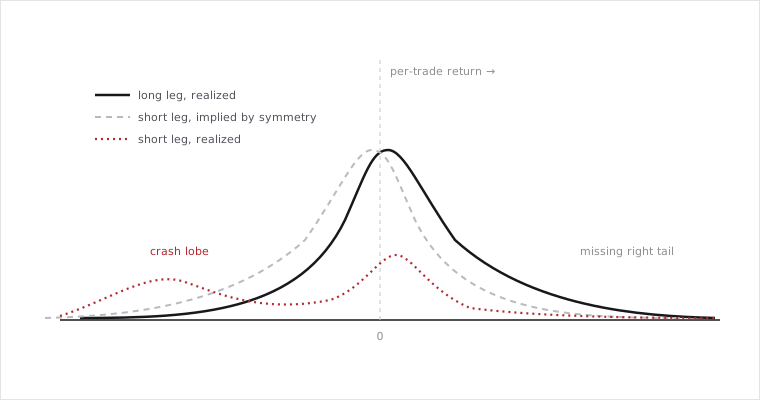
Fig. 1. This figure shows stylized per-trade return densities for three objects: the realized long leg (solid black), the short leg implied by the symmetry hypothesis — the long leg's reflection (dashed gray) — and the realized short leg (dotted red). The realized short leg lacks the reflected right tail and exhibits a distinct far-left crash lobe absent from the hypothesis. Densities are synthetic renderings of the qualitative pattern; scales are intentionally unspecified.
3. Why symmetry was always the weaker hypothesis
In retrospect — the retrospect being the only place practitioners are reliably intelligent — the asymmetry has structural causes that the syllogism ignores.
First, the two tails of a cross-sectional ranking are not populated by the same kind of firm. The literature on the short side of anomalies (Stambaugh, Yu, and Yuan 2012, among others) documents that anomaly returns concentrate in the short leg only within particular limits-to-arbitrage environments — hard-to-borrow names, high idiosyncratic risk, constrained shorting.2 Where those conditions do not hold, the short leg thins to nothing.
Second, the short side of any momentum-adjacent construction carries a payoff asymmetry the long side does not: the losses are unbounded exactly in the states where covering is most crowded. Daniel and Moskowitz (2016) document momentum's crash profile; a short portfolio is a standing invitation to those crashes.
Third — and this is the practitioner's clause the academic accounts rarely need — a signal is not an abstraction over prices but a machine tuned to a clientele and a window. Ours was built, end to end, around the dynamics of one side of the market in one slice of the day.3 There was never a theoretical reason its mirror image should describe the opposite side, any more than a key cut for one lock argues for its mirror opening another.
4. Conclusion
The short construction is buried, and the burial clarified something worth stating generally: every extension of a working strategy is a new strategy. Mirroring, inverting, hedging, doubling — each inherits the original's prestige while sharing none of its evidence. The syllogism that proposes them is free; the folds that judge them are not, and in our experience the folds' verdict on borrowed prestige is monotonously consistent.
Symmetry is beautiful in mathematics. In markets it is a prior with a loss rate.
Notes
- The test was run gross and net of realistic borrow assumptions; the rejection does not depend on financing frictions, though they deepen it. We flag this because "shorts fail after borrow" is the boring version of the finding, and it is not the version we obtained.
- The tug-of-war decomposition of Lou, Polk, and Skouras (2019) is suggestive on this point as well: their Table 2 finds several anomalies' short-leg premia concentrated in one component of the close-to-close return, consistent with the two legs being served by different clienteles at different times of day.
- This clause also disposes of a tempting rescue — running the mirror in a different window "where it might work." That is not a rescue of the hypothesis; it is a new strategy wearing its funeral suit, and it may apply for validation like everyone else.
References
Daniel, K., Moskowitz, T.J., 2016. Momentum crashes. Journal of Financial Economics 122, 221–247.
Lou, D., Polk, C., Skouras, S., 2019. A tug of war: overnight versus intraday expected returns. Journal of Financial Economics 134, 192–213.
Stambaugh, R.F., Yu, J., Yuan, Y., 2012. The short of it: investor sentiment and anomalies. Journal of Financial Economics 104, 288–302.
Keywords: short selling, anomaly asymmetry, limits to arbitrage, momentum crashes, Stambaugh-Yu-Yuan.