Working note No. 7 — on breadth, weighting schemes, and the instinct to spread.
Abstract. We report, in qualitative terms, the outcome of a family of portfolio-construction experiments: sweeping the number of names held, replacing rank-based selection with signal-strength weighting, substituting volatility-scaled sizing schemes, enforcing sector dispersion, and extending the tradable universe. Every intervention that made the portfolio broader, smoother, or more "diversified" made it worse — several of them decisively. We argue that for signals of a certain character, diversification is not a free lunch but a dilution: the portfolio-construction step cannot add information, it can only decide how faithfully to express what the signal knows. Ours, it turns out, knows something narrow.
1. Introduction
Portfolio construction is where systematic researchers go to feel like grown-ups. The signal is the creative act; the construction step is the responsible one — sizing, spreading, smoothing, the vocabulary of prudence. The literature supplies the instinct with a theorem: in the Grinold (1989) formulation,
IR ≈ IC · √BR,
the information ratio is the product of skill (IC) and the square root of breadth (BR), and the square root of breadth looks like a lever anyone can pull.
The theorem, however, defines BR as the number of independent bets per period — a premise the lever-pulling silently replaces with "the number of rows in the portfolio."1 We spent a season testing the difference in our own backtests. This note records the pattern of results.
2. Five interventions, one lesson
Breadth. Sweeping the number of names held produced an interior optimum — and it was sharp. Fig. 1 gives the stylized shape. Concentrating beyond the optimum hurt; but so, more instructively, did every step toward a broader portfolio. The marginal name added beyond the optimum contributed exposure and nothing else: BR in the Grinold sense had stopped growing even as the row count continued to.
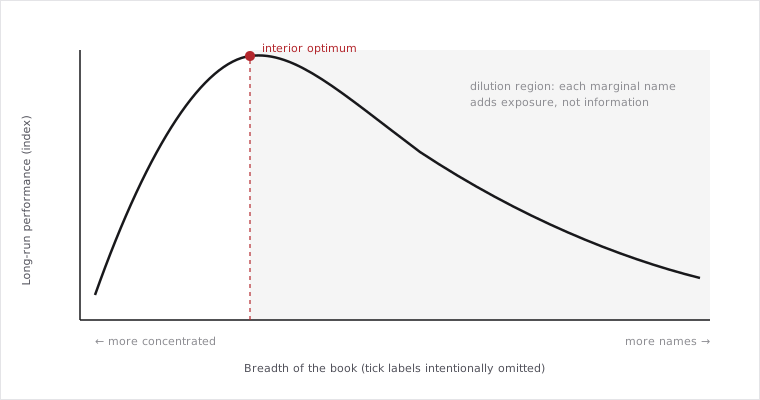
Fig. 1. This figure shows long-run strategy performance as a function of the number of names held, in stylized form. Performance rises steeply as the portfolio fills toward its natural width, peaks at a sharp interior optimum (red marker), and declines steadily thereafter as marginal names add exposure without information. Axis tick labels are intentionally omitted; the curve is synthetic and illustrative of the qualitative pattern only.
Weighting. Replacing flat allocations with signal-strength weights — betting more where the signal is louder — reads as obviously correct and failed clearly. The diagnosis, visible once we decomposed the bets: loud signals cluster, so weighting by loudness does not diversify conviction, it doubles a single theme. The scheme was not sizing information; it was leveraging correlation — reducing effective BR at the very step advertised as raising it.
Volatility scaling. Two variants of the industry-standard reflex — inverse-volatility at the name level, volatility targeting at the portfolio level (Carver, 2015) — both reduced long-run profitability in our tests.2 We state this narrowly: we do not claim vol-scaling fails in general; we claim it failed here, for a strategy whose payoff, as documented in an earlier note, is tail-concentrated. Scaling down after volatility arrives is, for such a payoff, a mechanism for being small precisely when the distribution is widest.
Dispersion constraints. Forcing the portfolio to spread across sectors — the intervention with the strongest prudential pedigree — produced the worst outcome of the family, degrading both return and its ratio to drawdown. The diagnostics pointed at a property of the signal we choose not to detail; it suffices to say that the constraint was not diversifying the bet, it was forbidding it.3
Universe extension. Widening the tradable universe diluted performance modestly but consistently. We record this result with some satisfaction despite its sign, because it doubles as a falsification test: had the edge been an artifact of universe selection, extension should have helped or been neutral. It did neither. The edge lives where it lives.
3. Conclusion
The five results share a structure. Each intervention implicitly assumed the signal's information was spread more widely than it is — across more names, more sectors, more of the strength distribution — and each was refuted in proportion to that assumption. The construction step, we conclude, has exactly one job: to express the signal at its natural width. Making the portfolio more comfortable than the signal warrants is not risk management. It is paying for a property — smoothness — that the signal never offered to fund.
Breadth is a multiplier only of what exists. Multiplying by what does not exist has a well-known result.
Notes
- The distinction is old and routinely ignored. Grinold and Kahn's own treatment is explicit that correlated bets do not add breadth; the practitioner literature's habit of reading BR as position count is a translation error with a cost attached.
- Both variants were evaluated over the full decade-length sample under the standard folds, not over episodes selected for volatility character. We have verified that neither result is driven by any single regime, though the margin of failure varies across them.
- The reader who suspects that this sentence conceals the most interesting finding in the note is correct, and we intend to keep it that way.
References
Carver, R., 2015. Systematic Trading: A Unique New Method for Designing Trading and Investing Systems. Harriman House, Petersfield.
Grinold, R.C., 1989. The fundamental law of active management. Journal of Portfolio Management 15 (3), 30–37.
Grinold, R.C., Kahn, R.N., 2000. Active Portfolio Management, 2nd ed. McGraw-Hill, New York.
Keywords: portfolio construction, breadth, signal weighting, volatility scaling, concentration, Grinold.