Working note No. 2 — on profit concentration and the hidden cost of protection.
Abstract. We examine a family of protective exit overlays — partial profit-taking, trailing stops, breakeven floors, and their laddered combinations — applied, in long-sample backtests, to a systematic strategy. Every design tested reduced long-run profitability, several of them severely. The mechanism is not subtle: the strategy's cumulative profit is overwhelmingly attributable to a small number of exceptional trades, and every form of protection we studied amounts to selling precisely that tail. We relate this finding to the broader literature on return concentration and argue that "protecting profits" is, for a class of strategies, a systematic transfer from one's best trades to one's sense of comfort.
1. Introduction
No instinct in the study of trading rules is more respectable than the instinct to protect a gain. It is prudent. It is what one's grandmother would advise. It survives every committee review, because the counterfactual — watching an open profit round-trip to zero — is vivid, while the cost of protection is diffuse and statistical.
We report here, in qualitative terms, what happened when we subjected that instinct to a validation protocol. The answer was unambiguous, and it was not close: across a dozen protective designs spanning the conventional taxonomy — partial exits at fixed multiples, trailing mechanisms of several speeds, breakeven floors, and laddered hybrids of these — not one improved the strategy.1 The best of them were merely expensive. The worst were ruinous.
2. The anatomy of the result
The mechanism becomes obvious the moment one looks at the distribution of per-trade outcomes rather than its mean. The strategy in question — like, we suspect, many short-horizon momentum-family strategies — earns its keep from the extreme right tail. The median trade is unremarkable. Cumulative profitability is attributable to a set of trades small enough to count without running out of fingers, each of which traveled much further than any reasonable ex-ante target. Fig. 1 renders the concentration in stylized form.
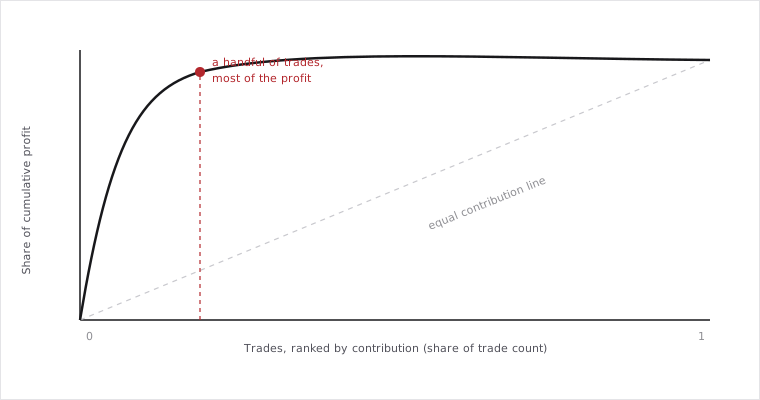
Fig. 1. This figure shows the cumulative share of strategy profit as a function of the share of trades, with trades ranked by contribution. Under equal contribution the curve would follow the dashed diagonal; the realized curve (solid black) rises nearly vertically — a small fraction of trades (red marker) accounts for the large majority of cumulative profit, and the remaining mass of trades contributes approximately nothing net. The curve is synthetic and illustrative; the underlying counts and shares are intentionally unspecified.
Against that distribution, consider what each protective device actually does. A partial exit converts a tail trade into half a tail trade. A trailing stop converts it into a timing lottery on the first adverse wiggle. A breakeven floor is subtler: it truncates the left tail slightly while — because tail trades routinely revisit their entry price early in their life — amputating the right tail as well. Each device, in other words, is a short position in exactly the moments the strategy exists to capture.
We found the symmetry almost pedagogically clean: the devices differ in mechanics, but they share a payoff signature — they sell convexity and receive comfort.2
3. Relation to what is known
The concentration itself should not have surprised us as much as it did. Bessembinder (2018) documents that the entire net wealth creation of the U.S. equity market over nine decades is attributable to roughly four percent of listed firms; the majority of stocks, individually, underperformed Treasury bills. Concentration of outcomes in a fat right tail is not an anomaly of our strategy; it appears to be a general property of risky asset payoffs at many horizons. Taleb (2001) supplies the behavioral corollary that our committee-room instincts are built for the median path and systematically mis-price the rare one — which is another way of saying that the demand for protective overlays is generated by exactly the psychology least equipped to price them.3 What we add, from the practitioner's side, is the observation that exit engineering is where this property goes to be violated. The literature's tail is an object of study; the researcher's tail is an object of interference.
4. What survived
The reader will ask what our exits look like now. We will disappoint him: the specifics stay home. What we can say is structural — the surviving configuration is radically simpler than anything in the tested family, and its governing principle is that no component may be short the right tail. Time, not price, does most of the work.
We hold the general lesson with some confidence: for strategies whose profitability is tail-concentrated, the burden of proof on any protective overlay should be extraordinary, because its expected effect — prior to any evidence — is to trade the distribution's best region for its most emotionally legible one.
Prudence, it turns out, has a short gamma profile.
Notes
- All of the designs were evaluated under the protocol of note No. 4 — combinatorially purged folds, criteria fixed ex ante — over an evaluation window long enough to contain several full episodes of the strategy's characteristic drawdown-and-recovery cycle. We have verified that no design's rejection hinges on any single episode.
- The options-literate reader will recognize the signature: each overlay replicates a short position in a call on the trade's excursion, financed by a premium received in units of reduced anxiety. The market for that premium is, in our experience, permanently overbid.
- Carver (2015) reaches the operational conclusion from a different route: a rule-based system's owner adds most of his value by not intervening — the interventions being, in the main, purchases of comfort at the price documented here.
References
Bessembinder, H., 2018. Do stocks outperform Treasury bills? Journal of Financial Economics 129, 440–457.
Carver, R., 2015. Systematic Trading: A Unique New Method for Designing Trading and Investing Systems. Harriman House, Petersfield.
Taleb, N.N., 2001. Fooled by Randomness: The Hidden Role of Chance in Life and in the Markets. Random House, New York.
Keywords: exit rules, profit concentration, right tail, trailing stops, convexity, Bessembinder.