Imagine a trading bot that not only executes trades but also learns from its past performance, refining its strategies over time without human intervention.
By leveraging OpenAI’s o1 model — a reasoning AI that thinks before it acts — this project explores the creation of a “self-healing” trading bot that analyzes its weekly performance, learns from past trades, and continuously improves its decision-making process.
Can the Latest AI Models Beat Human Traders?
We are testing whether the latest AI models can outperform human traders in the stock market. By utilizing advanced artificial intelligence designed for deliberate reasoning and problem-solving, we aim to assess if these models can make trading decisions more effectively than humans. Unlike traditional AI focused on speed, these cutting-edge models internally analyze complex tasks before acting, potentially giving them an edge in high-stakes trading scenarios.
Implementing the ‘Self-heal’ Approach
The core of our trading bot lies in its ability to “self-heal” — to autonomously analyze and improve its trading strategies based on past performance by leveraging OpenAI’s o1 model to adjust its own code.
img: Initial deploy
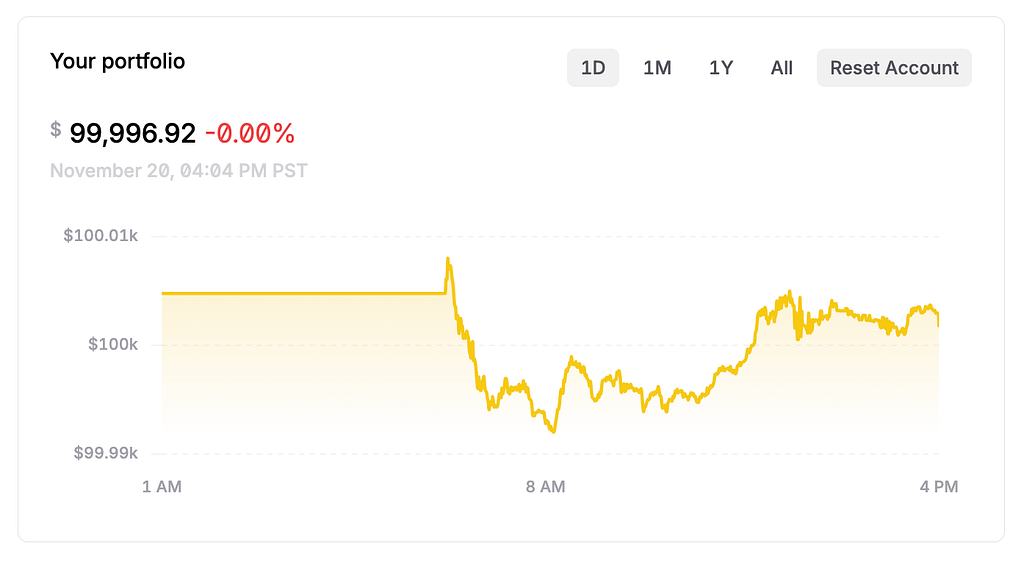
Here’s how this self-improvement works:
Performance/Strategy Analysis - At the end of each trading day, the bot conducts a thorough evaluation of its performance.
Trade Statistics: Win rate, Total trades, Profitable/losing trades count, Average profit/loss per trade, Average holding period
Risk Metrics: Value at Risk (VaR) at 95% and 99% confidence levels, Expected Shortfall (CVaR), Maximum drawdown, Sortino and Calmar ratios
Returns and Volatility: Total return, Sharpe ratio, Daily/monthly returns, Volatility
Data Integration — The bot retrieves and integrates: Historical Market Data / Alpaca & Yfinance, Trading History Logs / Mongodb
Strategy Refinement
Based on its analysis, the bot recalibrates its code: Adjusts Technical Indicators, Optimizes Position Sizing, Enhances Risk Management
Deployment: Docker image, AWS Elastic Container Registry (ECR), AWS Elastic Container Service (ECS).
From Initial Deployment
Day 1: A Promising Launch
$HIMS
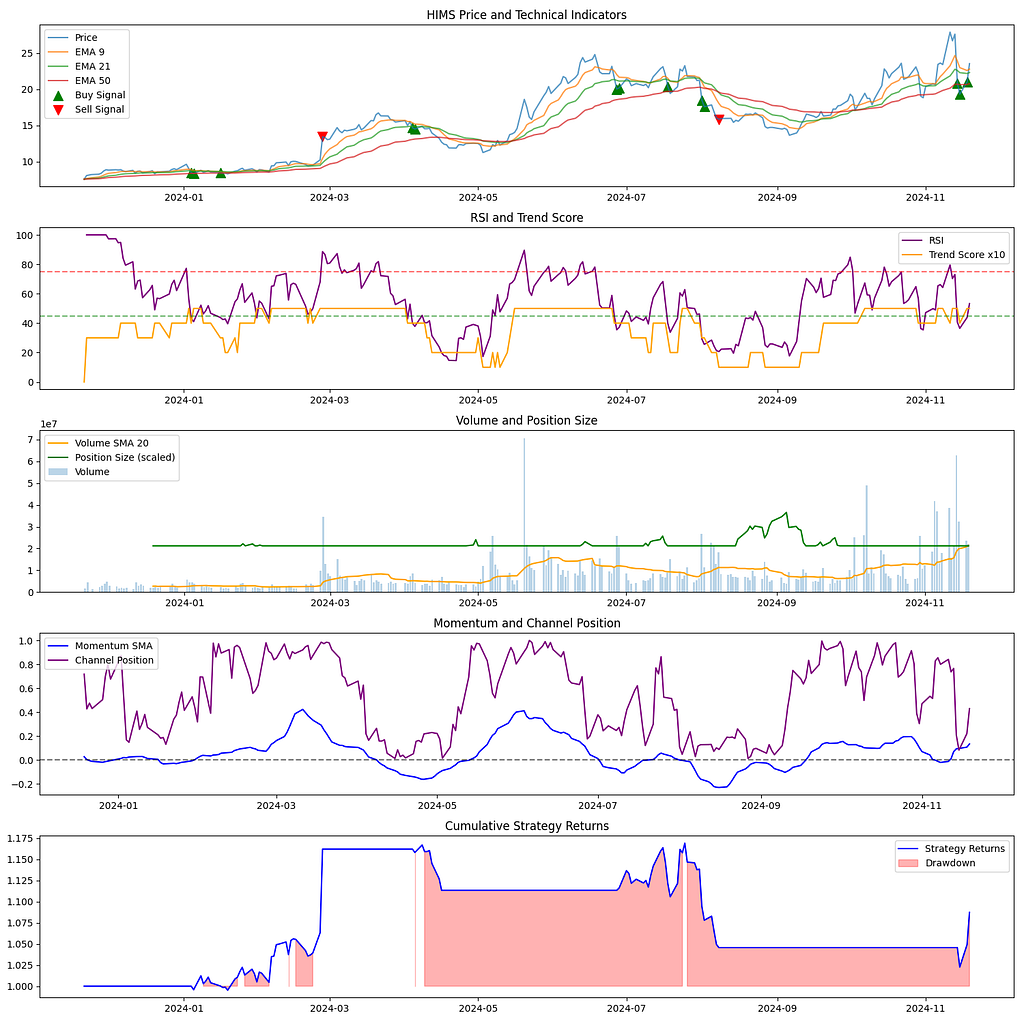
The initial deployment of the trading bot was encouraging. After setting up the infrastructure with Alpaca for trading and market data, and MongoDB for data storage, everything seemed to operate as intended. The bot successfully executed its first trades, integrated historical and real-time data seamlessly, and began collecting performance metrics. It was a solid start.
Day 2: Unforeseen Complications
However, the following day presented unexpected challenges. The o1 model, which was intended to adjust trading parameters to optimize performance, began making unintended changes to the codebase. Instead of solely tweaking parameters, the model altered significant portions of the code. With auto-deployment enabled, these unintended modifications were automatically pushed to production, leading to a cascade of issues:
- Docker Image Failures, ECS Failures
Day 3: Manual Fixes
Addressing these problems required fixing the codebase.
Day 4: Switching to Sonnet 3.5
Trying to avoid similar risks moving forward, we decided to switch to the Sonnet 3.5 model, known to perform better in code writing, hoping it would offer more reliable and controlled adjustments.
Unfortunately, the transition did not go as planned. Despite the improved safeguards, Sonet 3.5 also encountered issues:
- Unintended Code Changes: Similar to the o1 model, Sonet 3.5 began making unexpected alterations to the code, affecting both trading logic and other critical components.
- Deployment Failures: These changes led to further Docker image breakdowns and ECS disruptions, resulting in repeated downtimes.
The persistent issues with autonomous code modifications reinforced the challenges of balancing AI-driven optimization with system stability.
Day 4: Manual Adjustments
After the hectic first few days, we decided to take matters into our own hands by implementing changes based on the o1 model’s recommendations.
So far, the bot has been modestly successful, hitting up to ~3% gains daily. It’s important to note that the S&P 500 has been trading sideways recently, which limits trading opportunities. We’re hopeful that as market volatility picks up, the bot will perform even better.